Admixture
A product added in small doses while concrete is mixed to change how it behaves, such as a plasticiser that makes it flow more easily or a retarder that slows setting.

Press Enter to search every page, or pick a page below.
No page is called that. Search every page for “”, or ask us.
Resources
Plain-English definitions of the terms used on site, in the laboratory and on our test reports.
77 terms in 6 topics
A product added in small doses while concrete is mixed to change how it behaves, such as a plasticiser that makes it flow more easily or a retarder that slows setting.
The sand, gravel or crushed rock that makes up most of the volume of concrete. Fine aggregate is the sand fraction; coarse aggregate is the larger stone.
The volume of air in fresh concrete, given as a percentage. It is measured on site with a pressure meter that compresses a sealed sample.
Deliberately introducing millions of tiny, evenly spread air bubbles with an admixture. The bubbles give frost-exposed concrete room to cope with freezing water.
Water rising to the surface of freshly placed concrete as the heavier solids settle. Heavy bleeding can weaken the top layer.
The UK standard that sits alongside BS EN 206. It sets out how to specify concrete in the UK, including the mixes and cover needed for each exposure class.
Fresh concrete test series
The family of standards for testing fresh concrete: Part 1 sampling, Part 2 slump, Part 5 flow table, Part 6 density, Part 7 air content, Part 8 slump flow and Part 10 the L-box.
Hardened concrete test series
The family of standards for testing hardened concrete: Part 1 specimen and mould sizes, Part 2 making and curing specimens, Part 3 compressive strength and Part 7 density.
Testing concrete in structures
The standards for testing concrete already in a structure. Part 1 covers taking and testing cores; Part 2 covers the rebound hammer.
The European standard for specifying, producing and checking the conformity of concrete. Strength classes and consistence classes such as C32/40 and S3 come from it.
The standard method for grading aggregate by washing and sieving, used to find its particle size distribution.
Checking a measuring instrument against a reference of known accuracy and recording the difference. Test machines, thermometers and cube moulds are all calibrated.
GGBS, fly ash
Materials such as ground granulated blast-furnace slag (GGBS) or fly ash used in place of part of the cement. They often gain strength more slowly, which is why some mixes are judged at 56 days.
The strength that no more than 5% of results are expected to fall below. It is the figure a strength class guarantees, not an average.
Removing trapped air from fresh concrete by vibrating or rodding it. Cubes that are not fully compacted contain voids and test low.
A sample made by combining several portions taken across a delivery, so it represents the whole load.
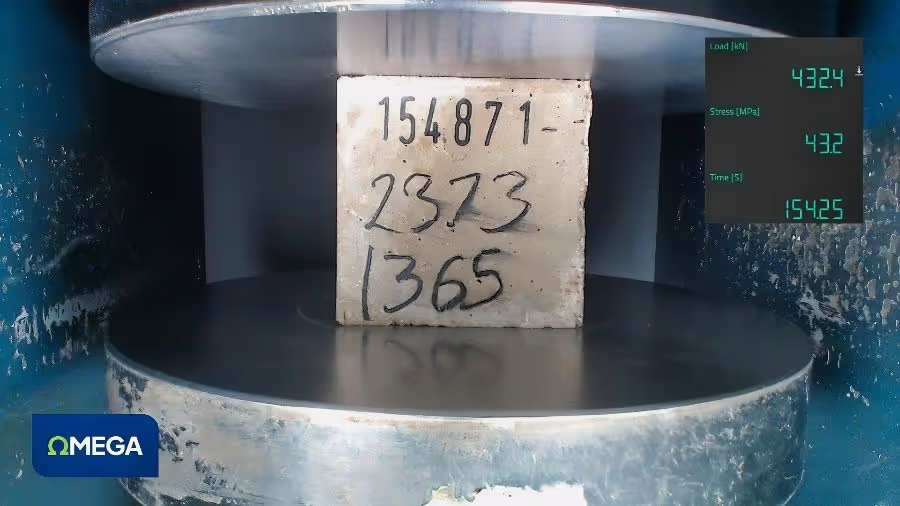
The press that loads a cube or core at a steady, controlled rate until it fails, recording the highest load carried.
The highest load a specimen carries before it fails, divided by the area of the face it was loaded on. It is reported in MPa (N/mm²).
Evidence that concrete meets its specification. Under BS EN 206 the producer is responsible for conformity testing of the concrete it supplies.
Workability class
The standard term for how stiff or fluid fresh concrete is. It is measured by the slump, flow table or slump flow test and specified as a class, such as S3.
Core sample
A cylinder of hardened concrete cut from a structure with a diamond core barrel, then tested to find the strength of the concrete in place.
A hollow, diamond-tipped drill bit. It cuts a clean ring through concrete and leaves the core inside the barrel.
Concrete cover
The depth of concrete between the surface and the nearest steel reinforcement. Enough cover protects the steel from corrosion and fire.
The Construction Skills Certification Scheme card, carried on site as proof of training and qualifications for the work being done.
Test cube
A 100 mm or 150 mm cube of concrete made from a sample taken on site, cured, then crushed to measure compressive strength.
Picking up cubes from site once they have hardened and taking them to the laboratory for curing and testing.
The steel or plastic box a cube is made in. Its size, squareness and flatness must stay within set tolerances or the cube cannot be tested fairly.
Keeping concrete moist and at the right temperature so it keeps gaining strength. Test cubes are cured in water held at (20 ± 2) °C.
A temperature-controlled water tank in which cubes are stored from demoulding until the day they are tested.
Delivery note
The supplier’s note that comes with each load, showing the mix, volume and batching time. Its details belong on the cube paperwork.
Taking a hardened cube out of its mould, normally between 16 hours and 3 days after making, before it goes into water curing.
Mass per unit volume, in kg/m³. Fresh density is measured on site; the density of each hardened cube is measured before it is crushed.
Coring
Cutting round holes through concrete with a diamond-tipped core barrel, either to take cores for testing or to form openings for services.
Type of fracture
The pattern a cube breaks in when crushed. The standard shows satisfactory and unsatisfactory patterns; an unsatisfactory one is recorded on the report.
Washout test
The amount of steel or polymer fibre in fresh concrete, found by washing a known volume and weighing the fibres left behind.
Slab cutting
Cutting straight lines through concrete slabs, roadways and pavements with a diamond blade, for joints, trenches and openings.
A consistence test for more fluid concrete. A cone of concrete is spread by jolting a hinged table, and the spread is measured.
Concrete from mixing until it sets, while it can still be placed and compacted. Slump, air content and cube making all happen at this stage.
Concrete once it has set and is gaining strength. Cubes, cores and rebound surveys all test hardened concrete.
Concrete Cube TestingOpen voids between the stones on a concrete surface, usually caused by poor compaction or grout leaking from formwork.
Tests carried out for the site, usually on cubes, to check that particular loads belong to concrete that conforms to its specification.
The strength of the concrete as it is in the structure, estimated from cores and, alongside them, rebound readings.
The international standard for the competence of testing and calibration laboratories. UKAS assesses laboratories against it.
The unit of force a test machine records. Strength is the load divided by the loaded area: 432.4 kN on a 100 mm cube face is 43.2 MPa.
Concrete Cube TestingA test for self-compacting concrete that measures how well it flows through a gate of reinforcing bars without blocking.
The range either side of a result within which the true value is expected to lie. Accredited laboratories estimate it for each test.
N/mm²
The unit of concrete strength. One MPa is one newton per square millimetre, so the two are interchangeable on a report.
The recipe for a concrete: the proportions of cement, water, aggregates and admixtures chosen to meet the strength, durability and workability needed.
Testing that leaves the structure undamaged, such as a rebound hammer survey. It does not replace cores where strength must be proved.
PSD, grading, sieve analysis
How much of an aggregate falls into each size band, found by passing it through a stack of sieves and weighing what each one holds.
Risk assessment and method statement
The documents that set out the hazards of a job, how they are controlled and the order in which the work is done.
Concrete batched at a plant and delivered to site in a truck mixer, ready to place.
Schmidt hammer
A spring-loaded hammer pressed against the concrete surface. How far its mass rebounds gives a quick, non-destructive guide to surface hardness and uniformity.
The reading a rebound hammer gives. Readings are taken in groups across a test area and compared, not read as strength on their own.
Taking fresh concrete from a delivery, in a set way, for testing and for making cubes. Every result depends on the sample being representative.
How often cubes are made for a pour, set by the specification, for example one set for every so many cubic metres placed.
The UKAS document that lists exactly which tests, to which standards and at which sites, a laboratory is accredited for.
Concrete fluid enough to flow into place and compact under its own weight, without vibration.
The concrete series of the Specification for Highway Works, used on road schemes. Clause 1707 sets cube sampling rates.
A framed mesh with square openings of a set size. A nest of sieves sorts aggregate into size bands.
The consistence band a mix is specified in, from S1 (stiff) to S5 (very fluid), each covering a range of slump in millimetres.
T500
The spread of self-compacting concrete released from a cone onto a flat plate. T500 is the time it takes to reach a 500 mm circle.
The most common site test for consistence. A 300 mm cone is filled, rodded and lifted, and the drop of the concrete is measured.
An extra cube made with a set and kept in curing, so it can be tested later if a result needs checking or a later age is wanted.
Concrete Cube TestingA sample taken from one part of a delivery, rather than spread across the whole load.
Drilling a line of overlapping cores to cut an opening through concrete, often where a saw cannot reach.
A label such as C32/40. The first number is the characteristic strength on cylinders, the second on cubes, both in MPa.
How old the cubes are, in days, when they are tested. Sets are commonly tested at 7 and 28 days, and at 56 days for slower-gaining mixes.
Test certificate
The issued record of a test: the sample details, the method and standard, each result and any observations, such as the failure mode.
Concrete Cube TestingAn unbroken chain of calibrations linking a measurement back to national standards, so results can be trusted and compared.
An account with Omega that lets you book work and pay on invoice rather than at the time of booking.
Billing & Accounts FAQA batch made in the laboratory to prove a mix design before it is used on a project, with its fresh properties and cube strengths recorded.
United Kingdom Accreditation Service
The UK’s national accreditation body. It assesses laboratories against ISO/IEC 17025 and accredits them for the specific tests on their schedule.
UKAS Accreditationw/c ratio
The mass of free water divided by the mass of cement in a mix. A lower ratio generally gives stronger, more durable concrete.
A location system that gives every 3 metre square a unique three-word address, useful for pinpointing exactly where cubes are left on a large site.
How easily fresh concrete can be mixed, placed and compacted. Consistence is the measured, specified side of workability.
Our team can explain it during office hours, 9 AM to 5 PM, Monday to Friday.
Call 01327 552077 or email team@theomegagroup.co.uk, 9 AM to 5 PM, Monday to Friday.