
The Omega Group (Operations) Limited is a UKAS accredited testing laboratory No. 7644.
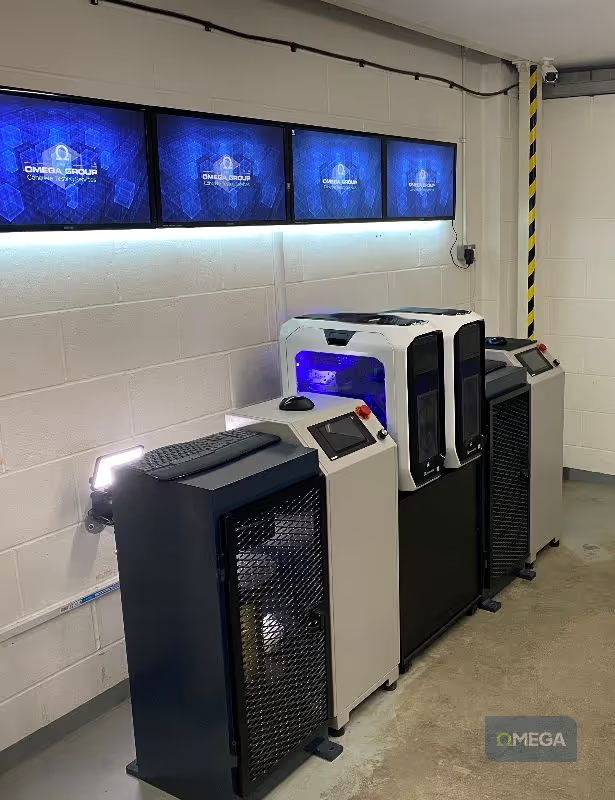
The Omega laboratory: wall-mounted screens and camera rigs above the compression machines.
  1. Home
  2. Laboratory
  3. The Journey of a Concrete Cube

The journey of a concrete cube

From the first scoop of fresh concrete to the recycling plant, every cube that passes through Omega follows the same eleven stops. This is what happens at each one, and the check that protects your result there.

  1. 01Made on site
  2. 02Collected and carried
  3. 03Booked in
  4. 04Demoulded, examined and stamped
  5. 05Cured in water
  6. 06Picked and weighed
  7. 07Tested to failure
  8. 08Verified
  9. 09Reported
  10. 10Held, in case it is needed
  11. 11Disposed of, recycled
  • One sample number

    Stamped into the cube itself at the examination bench, and written on every record from curing to disposal.

  • Nothing released unchecked

    Every result is compared with its set and reviewed by management before a report is issued.

  • Nothing to landfill

    Every tested cube leaves as recycled aggregate for new construction.

Before the cube exists

A good result starts before the pour

The cube is only as good as the plan behind it. Three things done early make the rest of the journey straightforward.

  • Book the work

    One-off, call-off or a regular schedule for collection, sampling or both. Quotes usually within 60 minutes during office hours.

    Get a Quote
  • Plan the sampling

    Pour volume and sampling rate turned into the number of cube sets to make, before the first truck arrives.

    Sampling rate calculator
  • Tell us about the pour

    The cube data sheet gives every cube its identity: site, mix, specified strength, date and time sampled, test ages, spares.

    Documents & Resources
Follow the cube

Eleven stops, one record

Follow the cube down the page. On the right, its record fills in as it passes each stop. The figures there are an illustration of a real record; the read-out is the one on our published test video.

01

On your siteDay 0

Made on site

The journey starts in the fresh concrete. When our technicians sample the pour, the cube is made the way the test assumes it was: a representative sample, a calibrated mould, proper compaction, a level finish and a first night kept warm and damp. Everything the laboratory does later depends on these first hours.

  • Fresh concrete sampled to BS EN 12350-1:2019 and cubes made to BS EN 12390-2:2019, both within our UKAS accreditation.
  • Slump, flow, fresh density and air content tested on site when they are part of the job, to the BS EN 12350 series.
  • Initial curing in the mould at (20 ± 5) °C, protected from drying, wind and frost, as the standard requires.
  • Made only by technicians trained and authorised for sampling and cube making, with a competence record on file.

Record keptSampling record and cube data sheet

Fresh concrete filled and finished in steel cube moulds on site.
02

In the collection vanDay 1

Collected and carried

Our technician lifts the cubes into a padded collection crate. On the weekly run for your region, or a collection booked for the day, the crate travels in a company van straight to Daventry. Nothing is left in a yard or handed to a courier; the cube stays with us from the moment it is picked up.

  • Weekly collection runs across the UK by region, with one-off, call-off and scheduled collections to suit the project.
  • Packed into padded collection crates so cubes are not knocked, cracked or chipped in transit.
  • Carried by our own insured technicians in company vans, never by a third party.
  • Delivered to the laboratory for immediate, temperature-controlled curing.

Record keptCollection record

An Omega collection van travelling on a UK motorway.
03

Goods In, DaventryDay 1

Booked in

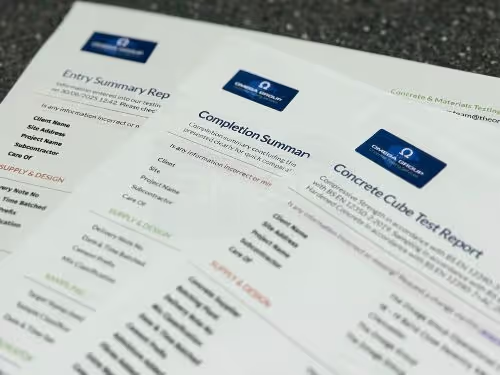
Every cube is counted, checked against your paperwork and entered on our system before it goes anywhere else. If the pour data has not arrived with the cubes, the cubes go into curing anyway and your contacts are asked for the data on a set schedule. Once the group is booked in you receive an Entry Summary listing each cube and the date it will be tested.

  • Date and time received, quantity and size recorded against your account and site.
  • Cubes received without the sample data are held in curing and the data requested from your contacts on a set schedule, as our Terms set out.
  • An Entry Summary emailed to your nominated contacts, listing every cube, its test age and its test date.
  • A cube that arrives after its booked test age is tested on receipt, and the report says so.
  • Cubes made by others carry a note that the result applies to the specimen as received.

Record keptReceipt record and Entry Summary

Printed Entry, Completion and Concrete Cube Test Report documents on a desk.
04

The examination benchDay 1

Demoulded, examined and stamped

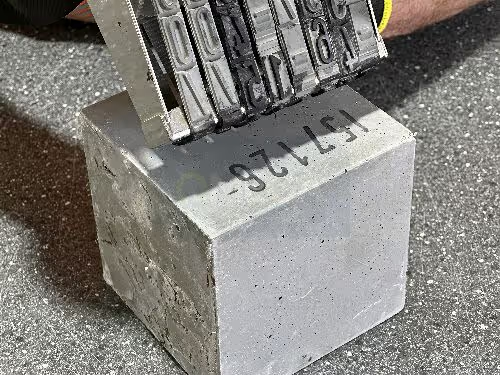
Out of the mould, the cube is looked at properly before anything else happens to it. A technician measures it, checks the faces are flat and square, and looks for cracks, chips, honeycombing or a poor finish. Then its unique sample number is stamped into several faces, so the cube and its record can never be parted.

  • Demoulded after initial curing and checked for damage before it enters the laboratory system.
  • Dimensions measured with calibrated callipers; size, shape and flatness checked against BS EN 12390-1:2021.
  • Visible defects noted on the record: cracks, chips, honeycombing, out-of-shape faces.
  • A unique sample number stamped into several faces, and the cube’s location tracked from this point on.
  • Cubes outside the standard’s tolerances are noted on the report, with what was found.

Record keptExamination record and unique sample number

A metal stamp pressing a unique sample number into the face of a concrete cube.
05

A curing tankDays 1 to 28

Cured in water

The cube spends most of its life here, under water held at (20 ± 2) °C. Its tank and grid position are recorded when it goes in, so we know exactly where it is. The tank temperature is read and logged three times every working day, and when the cube comes out for testing its own curing record is written against it.

  • Water curing at (20 ± 2) °C to BS EN 12390-2:2019, with the laboratory held between 15 and 25 °C.
  • Every tank’s temperature read and logged three times each working day.
  • The cube’s tank and grid position recorded with the time it went in and the time it came out.
  • The mean, lowest and highest temperature the cube was cured at, taken from the tank log, written to its record at test.
  • A tank out of specification is taken out of use, and no cube is placed in it until it is back within range.

Record keptTank temperature log and the cube’s curing record

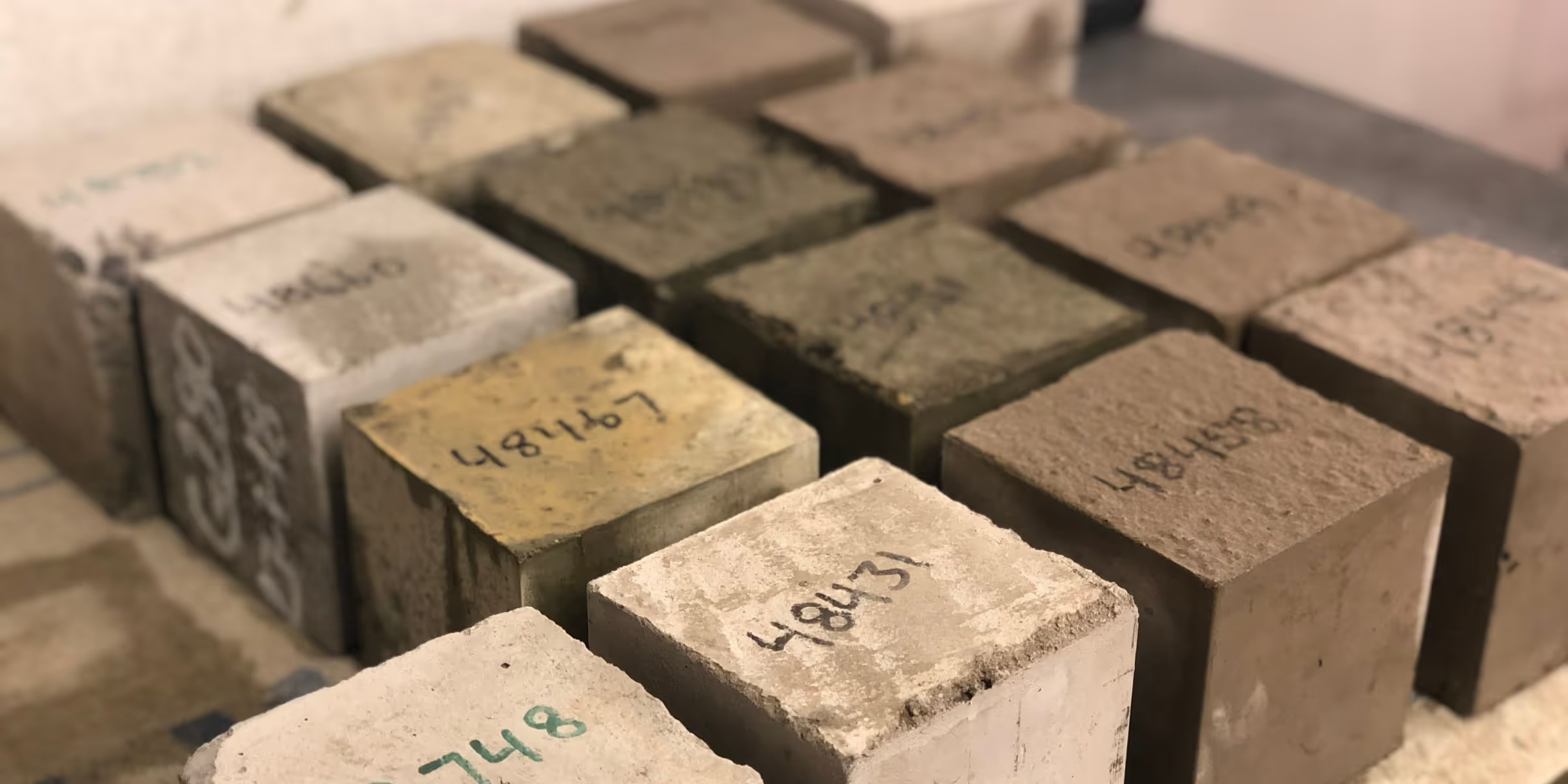
Numbered concrete cubes under water in a laboratory curing tank.
06

The test bayDay 28, morning

Picked and weighed

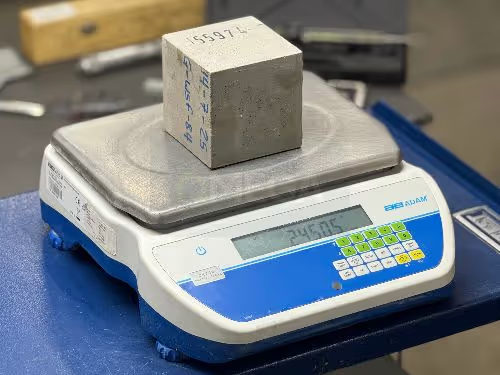
On the scheduled day the cube is lifted out of its tank, its surface water wiped away, and its age checked against the date and time it was sampled. It is weighed in air and in water to find its density. Density is the first number that tells us whether this cube is like the rest of its set.

  • Picked on the scheduled test day; the test age is calculated from the recorded sampling date and time.
  • Density measured by weighing in air and in water to BS EN 12390-7:2019, reported in kg/m³.
  • The balance is checked daily and calibrated on a schedule, with certificates on file.

Record keptDensity record

A concrete cube on a laboratory balance showing its mass in air.
07

The compression machineDay 28

Tested to failure

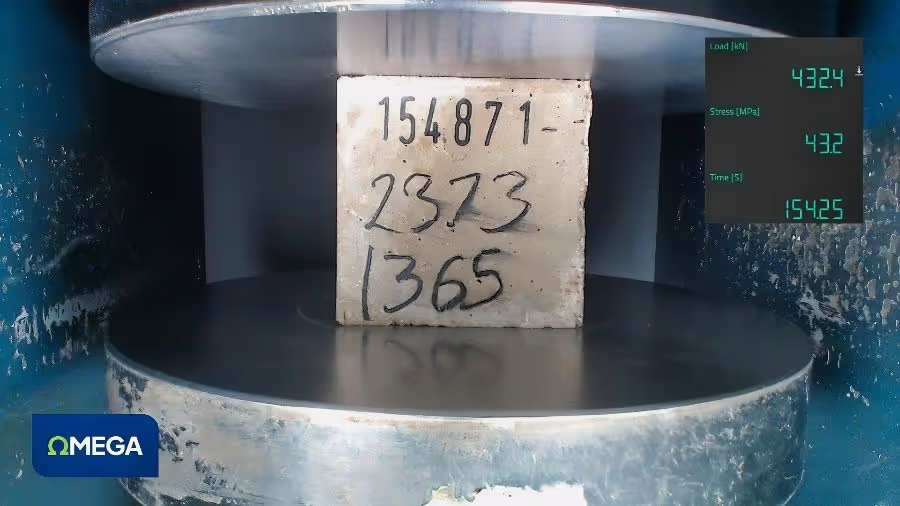
The cube is centred on the platens and loaded at the constant rate the standard sets until it fails. The camera runs the whole time, with load, stress and elapsed time on screen, so the moment and the manner of failure are kept, not just the number. The maximum load is recorded and the compressive strength calculated from the measured cross-section.

  • Tested to BS EN 12390-3:2019 on compression machines with current UKAS calibration, capable of 3,000 kN.
  • Loaded at the standard’s constant rate; maximum load, strength and the type of failure recorded.
  • Every test filmed and photographed, with load (kN), stress (MPa) and time on screen; videos kept for 12 months.
  • Machines checked at the start of every working day before the first test.

Record keptTest record, machine used, photograph and video

A concrete cube under load between the platens of a compression machine.
08

The compliance deskDay 28

Verified

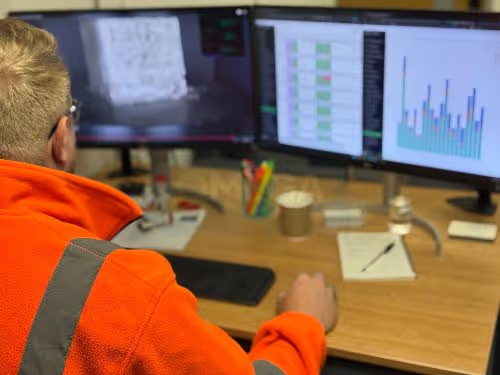
No result leaves on the strength of one person’s reading. Our compliance team compares the result with the other cubes in the set, with the earlier ages of the same concrete and with its density, and looks at the video if anything is out of pattern. A report is only released once the result has been reviewed and authorised.

  • Every result reviewed and authorised by management before release, as ISO/IEC 17025:2017 requires.
  • Compared with the rest of its set, the earlier ages of the same concrete and its density; trends watched across the project.
  • No message states or implies a result until that review is complete.

Record keptVerification record: who released the result and when

A reviewer in a high-visibility jacket checking test results on two monitors.
09

Your inboxDay 28, same day

Reported

The PDF test report is emailed on the day the cube is tested, to you and to anyone you have nominated, such as your engineer or consultant. It carries everything needed to judge the concrete: the reference, the age, the density, the failing load, the strength and the type of failure. When the last cube in the group has been tested you receive a Completion Summary.

  • PDF test report emailed on the day of testing, 99.9% of the time.
  • Each report states the sample reference, test age, density, failing load in kN, compressive strength in N/mm² and the type of failure, to BS EN 12390-3:2019.
  • Sent to your nominated contacts and, if you wish, directly to your consultant.
  • A Completion Summary when the group is finished, and a correction route if any detail on a report needs changing.

Record keptIssued report and its distribution

Printed Omega test reports spread across a desk.
10

The retention shelfDay 28 onward

Held, in case it is needed

A cube that has done its job is not thrown away at once. Spare cubes stay in curing until the retention date we give you when they are booked in, so there is a specimen left if a result needs a second look. A cube that did not reach its target at 28 days or later is moved to a separate, controlled area and kept so it can be examined.

  • If one of two 28-day cubes does not reach its target, the second cube is retained and tested only on your instruction.
  • Cubes at 28 days or older that did not reach their target are kept in a separate, controlled area for 30 days from the test date before disposal.
  • Spare cubes held in curing until the retention date set when they are booked in, as our Terms set out.
  • Cubes tested at 7 or 14 days are disposed of after testing unless you ask us to keep them.

Record keptRetention date on every cube

Rows of numbered hardened concrete cubes held in the laboratory.
11

The skip, then the recycling plantDay 59 onward

Disposed of, recycled

The last stop. Once the retention period has passed, the cube goes into the concrete skip. A licensed waste management company collects it, crushes it with every other tested cube and processes the material into recycled aggregate for new construction. None of it goes to landfill.

  • All tested cubes collected by a licensed waste management company.
  • Concrete is inert waste: crushed, processed and recycled as aggregate for other construction projects, none to landfill.
  • Around 48 tonnes of tested concrete recovered a year, as set out in our Carbon Reduction Plan.

Record keptLicensed waste collection, recycled as aggregate

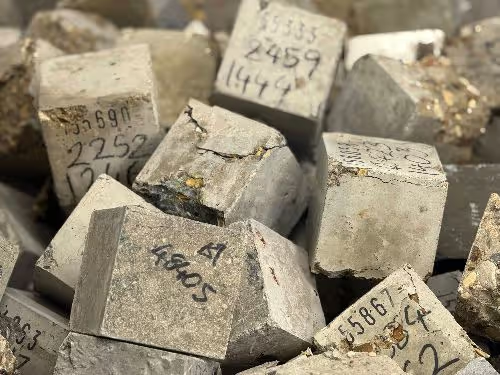
Broken concrete cubes, each still showing its sample number, in a waste skip.
Under every stop

The system behind the record

UKAS accredited

Assessed by UKAS against ISO/IEC 17025:2017 for the tests on our schedule: sampling, cube making, curing, density and compressive strength.

Calibrated equipment

Compression machines, balances and measuring equipment calibrated on a schedule, with certificates on file.

Standards kept current

Every method standard we work to is checked against BSI, so a change in the standard reaches the bench.

Compared with other laboratories

Interlaboratory comparisons and regular comparisons within our own laboratory.

One record per cube

Every stop writes to the same record, from the sampling date to the disposal date, under one sample number.

Management review

The whole system reviewed by senior management every year, and the laboratory assessed by UKAS.

Questions

About the journey

Does the cube ever leave your control?

Not once we have it. Our own technicians collect it in a company van, it is booked in at our Daventry laboratory, and it stays on our premises until it is collected for recycling. We do not use couriers or third-party storage.

How do you know which cube is which?

Each cube is stamped with a unique sample number on several faces when it is examined, and that number follows it through curing, testing, reporting and disposal. Its tank and grid position are recorded, so a cube can be found at any time.

What does the journey look like for cubes we make ourselves?

It begins at Goods In. From booking in to recycling every stop is the same, and the test is carried out and reported in the same way. The difference is at the start: when we make the cube, sampling and making are within our accreditation and the result is evidence of the concrete. When the cube is made by others, the result describes the specimen as it reached us.

How long is a cube kept after testing?

A cube tested at 7 or 14 days is disposed of after testing unless you ask otherwise. A cube at 28 days or older that did not reach its target is kept in a separate area for 30 days from the test date. Spare cubes are held until the retention date given when they were booked in. Test videos are kept for 12 months.

Where do the crushed cubes end up?

In new construction. A licensed waste management company collects the concrete skip, crushes and processes the material and sells it as recycled aggregate. Tested concrete from our laboratory does not go to landfill.

The Omega Group (Operations) Limited is a UKAS accredited testing laboratory No. 7644.

Accredited to ISO/IEC 17025:2017 for the tests on its schedule of accreditation.