
The Omega Group (Operations) Limited is a UKAS accredited testing laboratory No. 7644.
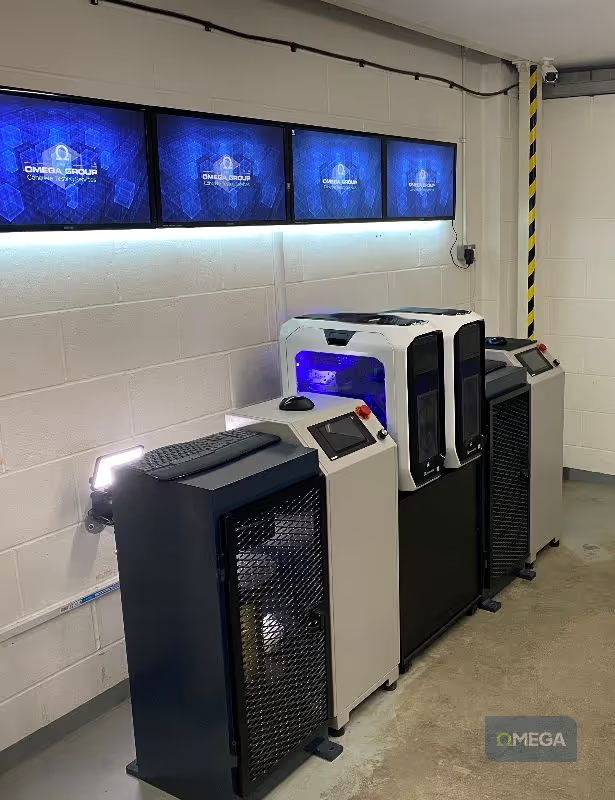
The Omega laboratory: wall-mounted screens and camera rigs above the compression machines.
  1. Home
  2. Company
  3. Quality Assurance

Quality assurance

Six layers between the concrete and the number on your report

A strength result is only worth what stands behind it. Here is what stands behind ours: trained people, compliance gates, round-the-clock monitoring, pattern checks, calibrated equipment and a laboratory system we built ourselves, applied to every specimen in the order it meets them.

  1. People
  2. Checkpoints
  3. Monitoring
  4. Patterns
  5. Equipment
  6. Omega Connect
The six layers

None of them is enough on its own. Together they make a result very hard to get wrong.

Accreditation sets the standard. These are the six things we do, every day, to meet it on every specimen. Each one is applied at the gates below, and each has its own section further down.

  1. 01

    Trained, assessed, authorised

    Nobody tests unsupervised until they have been trained, watched and signed off for that method.

    More
  2. 02

    Compliance gates, not habits

    Eight points where the specimen must satisfy a written procedure before it can move on.

    More
  3. 03

    Temperature and environment, around the clock

    Curing tanks and the laboratory itself are watched continuously, and every specimen carries its own curing record.

    More
  4. 04

    Results read as a family, not a number

    Every result is compared with its set, the earlier ages of the same concrete and its density before anyone sees it.

    More
  5. 05

    Calibrated, checked, traceable

    Compression machines, balances and measuring kit calibrated on a schedule and checked before the first test of the day.

    More
  6. 06

    Our in-house LIMS

    One record per specimen, written at every gate by the laboratory system we designed and built ourselves.

    More
The timeline

Eight gates. A specimen passes each one or it waits.

Follow a cube from Goods In to the retention shelf. At every gate the card says what must be true for it to move on, the checks behind that, and what would hold it there. On the right, the six layers fill in as the gates are passed.

01

Goods In, DaventryGate 01 of 08

Booked in against your paperwork

To passEvery specimen is counted, matched to your cube data and given a record before it goes anywhere else.

The first gate is a desk, not a machine. The crate is opened, the cubes are counted against your paperwork and each one is entered in Omega Connect with the date and time it arrived, its size and the ages it is to be tested at. The system then works out every test date itself, so no one is counting days on a calendar.

  • Date and time received, quantity and cube size recorded against your account and site.
  • Test dates calculated by Omega Connect from the sampling date and time on your paperwork.
  • An Entry Summary emailed to your nominated contacts listing every cube, its test age and its test date.
  • Cubes that arrive without their data are placed in curing and the data requested from your contacts on a set schedule.
  • A cube that arrives after its booked test age is tested on receipt and the report says so.

Held ifThe paperwork and the cubes disagree. The cubes go into curing and nothing is tested until the record is right.

  • Checkpoints
  • Omega Connect
  • People
Printed Entry, Completion and Concrete Cube Test Report documents on a desk.
02

The examination benchGate 02 of 08

Measured, inspected and stamped

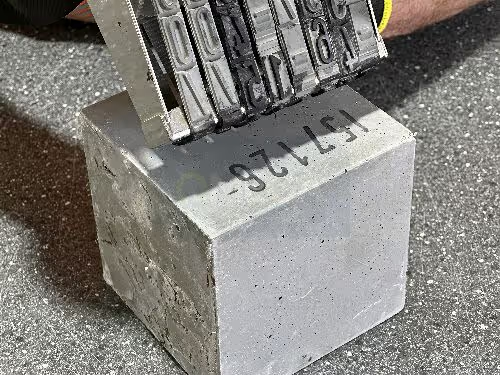
To passA technician measures the cube, checks its faces and condition and stamps its unique number into it.

Out of the mould, the cube is looked at before it is trusted. Calibrated callipers check its size and shape against the standard, the faces are checked for flatness, and any crack, chip or honeycombing is written down. Then the sample number is stamped into several faces, so the cube and its record can never be separated.

  • Dimensions measured with calibrated callipers; size, shape and flatness checked against BS EN 12390-1:2021.
  • Visible defects noted on the record: cracks, chips, honeycombing, out-of-shape faces.
  • A unique sample number stamped into several faces and the cube’s location tracked from this point on.
  • Cubes outside the standard’s tolerances noted on the report, with what was found.

Held ifThe cube is out of tolerance or damaged. It is flagged on its record so the result is read with that in mind.

  • People
  • Equipment
  • Checkpoints
  • Omega Connect
A metal stamp pressing a unique sample number into the face of a concrete cube.
03

A curing tankGate 03 of 08

Cured under constant watch

To passThe cube spends its life in water at (20 ± 2) °C, in a tank whose temperature is logged, and leaves with its own curing record.

This is where most of a cube’s life is spent, and where quiet problems would hide if nobody was looking. Tank and grid position are recorded the moment it goes in. Tank temperatures are logged through the day, the laboratory itself is held within range, and a tank that drifts is taken out of use. When the cube comes out, the mean, lowest and highest temperature it was cured at are written to its record.

  • Water curing at (20 ± 2) °C to BS EN 12390-2:2019, with the laboratory held between 15 and 25 °C.
  • Every tank’s temperature read and logged three times each working day.
  • Electronic temperature loggers in the tanks and the laboratory record continuously, day and night, and raise an alert if a reading leaves its range.
  • Tank and grid position recorded with the time the cube went in and the time it came out.
  • The mean, lowest and highest temperature the cube was cured at written to its record when it is tested.
  • A tank out of specification is taken out of use until it is back within range.

Held ifA tank reading leaves its range. The tank comes out of use and the curing record of every cube in it says what happened.

  • Monitoring
  • Equipment
  • Omega Connect
Numbered concrete cubes under water in a laboratory curing tank.
04

The test bayGate 04 of 08

Picked on the right day and weighed

To passThe test age is confirmed by the system, and density is measured before the cube goes anywhere near a machine.

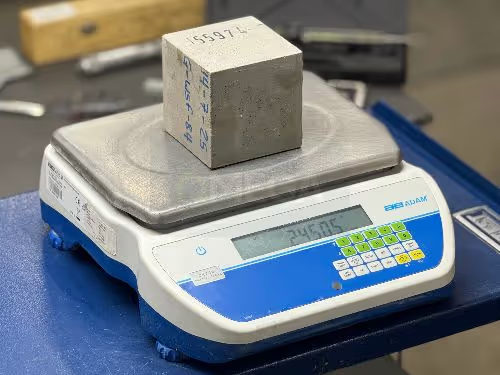
On the morning of the test the cube is lifted out, wiped and weighed in air and in water. Density is the first number that says whether this cube belongs with the rest of its set. A cube that is lighter than its brothers has usually been made or cured differently, and that is worth knowing before the strength result arrives.

  • Picked on the test day set by Omega Connect, so a cube cannot be tested a day early or late by mistake.
  • Density measured by weighing in air and in water to BS EN 12390-7:2019 and reported in kg/m³.
  • The balance checked every working day and calibrated on a schedule, with certificates on file.

Held ifThe density is out of family. The result is reviewed with that in view, and the cube is examined again if it needs to be.

  • Equipment
  • Patterns
  • Omega Connect
A concrete cube on a laboratory balance showing its mass in air.
05

The compression machineGate 05 of 08

Loaded to failure, on camera

To passA calibrated machine, checked that morning, loads the cube at the standard rate while the camera records everything.

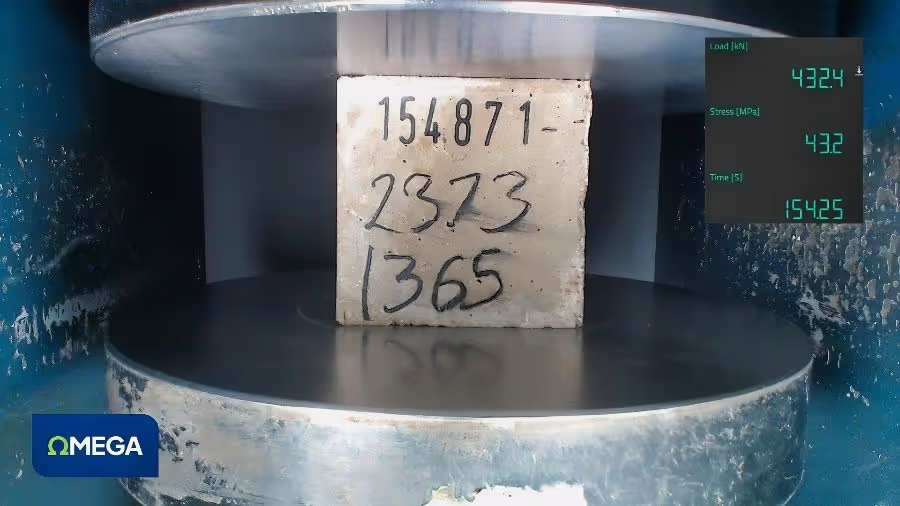
The cube is centred on the platens and loaded at the constant rate the standard sets until it fails. Load, stress and elapsed time run on screen and are filmed, so the moment and manner of failure are kept with the number. The maximum load passes into Omega Connect and the strength is calculated from the measured cross-section, not a nominal one.

  • Tested to BS EN 12390-3:2019 on compression machines with current UKAS calibration, capable of 3,000 kN.
  • Every machine checked at the start of each working day before the first test.
  • Loaded at the standard’s constant rate; maximum load, strength and type of failure recorded.
  • Every test filmed and photographed with load, stress and time on screen; videos kept for 12 months.

Held ifThe failure is not a satisfactory one, or the figure cannot be right. The record says so and the result does not pass quietly.

  • Equipment
  • People
  • Checkpoints
  • Omega Connect
A concrete cube under load between the platens of a compression machine.
06

The compliance deskGate 06 of 08

Read as a pattern, not a number

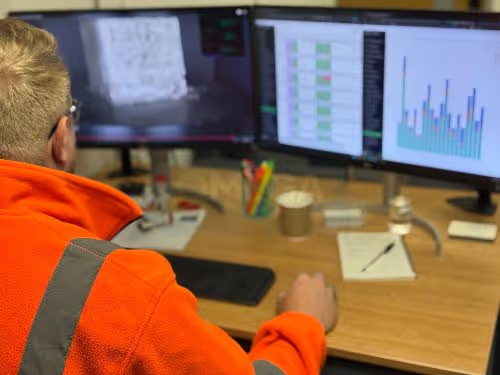
To passA manager compares the result with its set, the earlier ages of the same concrete, its density and the project before anything is released.

No result leaves on the strength of one reading. Omega Connect lays the new result beside the rest of its set, the 7 and 14 day results of the same concrete, its density and the trend across the project. A pair that disagrees, a 28 day cube below its 7 day, a density that stands apart: each is a question to answer, and the video is there to answer it. Only then does a manager authorise release.

  • Every result reviewed and authorised by management before release, as ISO/IEC 17025:2017 requires.
  • Compared with the rest of its set, the earlier ages of the same concrete and its density; trends watched across the project.
  • No email or message states or implies a result until that review is complete.

Held ifAnything out of pattern. The result is held, investigated and, where it matters, discussed with you before it is issued.

  • Patterns
  • People
  • Checkpoints
  • Omega Connect
A reviewer in a high-visibility jacket checking test results on two monitors.
07

Your inboxGate 07 of 08

Released the same day, in full

To passThe PDF report carries every figure needed to judge the concrete and goes only to the people you have named.

Once authorised, the report is generated from the record itself, so what you read is what was measured. It is emailed on the day of the test to your nominated contacts, and if you wish straight to your engineer. When the last cube in a group has been tested you receive a Completion Summary.

  • PDF test report emailed on the day of testing, 99.9% of the time.
  • Each report states the sample reference, test age, density, failing load in kN, compressive strength in N/mm² and the type of failure.
  • Sent to your nominated contacts and, if you wish, directly to your consultant.
  • A Completion Summary when the group is finished, and a written correction route if any detail needs changing.

Held ifA detail on the report is wrong. It is corrected through a recorded route and the report reissued, never quietly edited.

  • Checkpoints
  • Omega Connect
A compression machine screen showing load, stress and time during a filmed cube test.
08

The retention shelfGate 08 of 08

Kept, in case anyone needs to look again

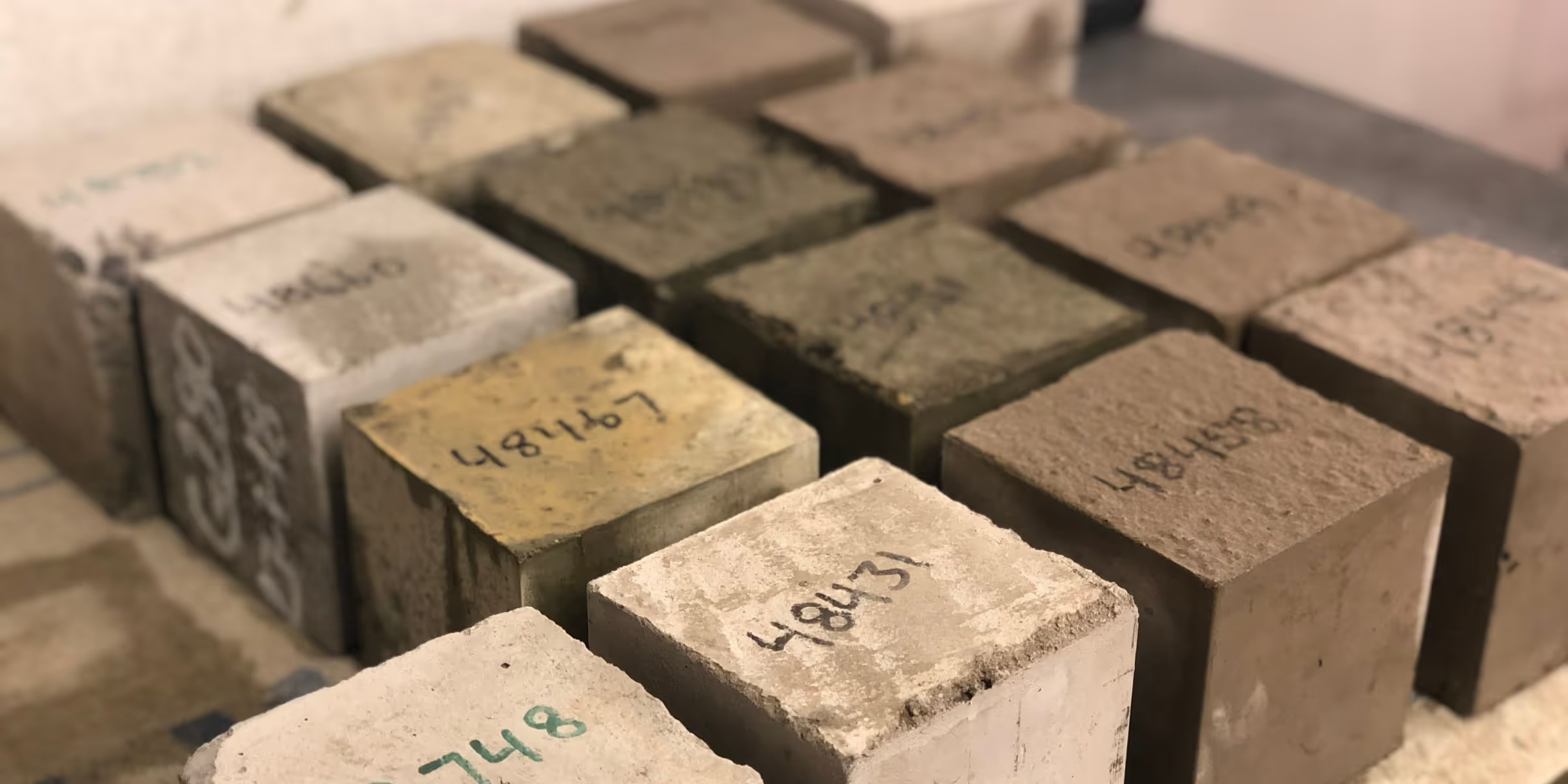
To passSpare cubes, low cubes and every video stay available, so a result can be revisited instead of argued about.

The last gate is patience. A spare cube stays in curing until the retention date on its record. A cube that did not reach its target at 28 days or later is moved to a separate, controlled area and kept so it can be examined. The video of every test is kept for a year. The record itself is kept for good.

  • If one of two 28-day cubes does not reach its target, the second is retained and tested only on your instruction.
  • Cubes at 28 days or older that did not reach their target kept in a separate, controlled area for 30 days from the test date.
  • Spare cubes held in curing until the retention date set when they were booked in, as our Terms set out.
  • Test videos kept for 12 months; the specimen record kept permanently.

Held ifA result is questioned. The spare, the video and the record are all still there to settle it.

  • Checkpoints
  • Omega Connect
Rows of numbered hardened concrete cubes held in the laboratory.
Layer 03 · Monitoring

Watched around the clock, because curing never stops

A cube spends 27 of its 28 days in a tank. The strength it reaches depends on that water staying at (20 ± 2) °C all day and all night, including the nights nobody is in the building.

Each tank’s temperature is logged through the working day and the laboratory air is held within its own range. A tank that drifts is taken out of use. When a cube is tested, the mean, lowest and highest temperature it was cured at are taken from the tank log and written to its record, so curing is a measurement on the file, not an assumption.

  • 20 ± 2 °CCuring water, to the standard
  • 15 to 25 °CThe laboratory air
  • 3 a dayLogged tank readings, every working day
  • Mean, low, highWritten to every cube at test
Curing tankIllustrative 36 hours
222018 Yesterday 09:00OvernightToday 09:00

The shaded band is (20 ± 2) °C. A trace that leaves it takes the tank out of use and goes on the record of every cube inside.

Layer 04 · Patterns

A result is read against its family before anyone reads it alone

A single number cannot tell you whether it is right. Its pair, the earlier ages of the same concrete, its density and the history of the project can. Omega Connect puts all of them on one screen for the manager who releases the result, and increasingly it stops the odd one itself.

One set of resultsIllustrative
Target C40 Pair 1Pair 2Pair 3 Held: pair disagrees Bars: 28 day strength · dots: the same concrete at 7 days
  1. 01

    The pair

    Two cubes of the same age should agree. A wide spread between them says something about the cubes, the curing or the machine before it says anything about the concrete.

  2. 02

    The ages

    Strength should rise with age. A 28 day result below the 7 or 14 day result of the same concrete is impossible for the concrete, so it is a question for us.

  3. 03

    The density

    Cubes from one pour share a density. One that stands apart was usually made or cured differently, and its strength is read with that in mind.

  4. 04

    The project

    Results are watched across the whole job. A mix that is drifting down shows itself here weeks before a single failed cube would.

Layer 05 · Equipment

The number is only as good as the machine that produced it

Every instrument that touches a result is calibrated on a schedule, checked before it is used and taken out of service the moment either lapses. Certificates are on file and traceable.

  • Compression machines

    UKAS calibrated, capable of 3,000 kN, checked at the start of every working day before the first test.

  • Balances

    Checked every working day with reference masses and calibrated on a schedule, certificates on file.

  • Callipers and rules

    Calibrated, so a cube’s dimensions and its calculated strength are traceable.

  • Curing tanks

    Temperature controlled to (20 ± 2) °C, logged, and taken out of use the moment one drifts.

  • Temperature loggers

    Calibrated loggers in the tanks and the laboratory, so the curing record is a measurement, not a memory.

  • Out of calibration means out of use. No piece of measuring equipment is used past its calibration date.
  • Calibration providers and partner laboratories evaluated every year.
  • Every method standard we work to is checked against BSI each week, so a change in the standard reaches the bench.
  • Interlaboratory comparisons and regular comparisons within our own laboratory.
An Omega trainer in orange PPE instructing delegates on making concrete cubes.
Layer 01 · People

Trained, assessed and authorised, then watched at work

Equipment and systems catch a great deal. The person at the bench is still the first line. Ours are trained to the standards they test to, assessed before they work alone and audited while they work.

  • CSCS-carded technicians trained to sample, make and cure cubes to BS EN 12350-1:2019 and BS EN 12390-2:2019.
  • Each person assessed and authorised for every method before working unsupervised, with a competence record on file.
  • Technicians witnessed at work on site and in the laboratory by the Quality Manager, on a programme of audits.
  • A Technical Manager and a Quality Manager named for the laboratory, each with a deputy.
  • The whole system reviewed by senior management every year and assessed by UKAS.
  • We train the industry: sampling, slump and cube making taught on client sites to the same standards we test to.

Training for your team

Layer 02 · Checkpoints

What all of this means for the result in your hand

The gates exist for one reason: so that the figure on your report can be acted on without a second thought, and defended without a second test.

  1. 01

    A strength you can act on

    The number on the report has been measured on calibrated equipment, by an authorised person, and read against its family before you see it.

  2. 02

    An early warning, not a surprise

    Drift in a mix, a curing problem on site or a pair that keeps disagreeing shows up in the pattern checks weeks before a failed cube would.

  3. 03

    Evidence if anyone asks

    Record, video, curing log and spare cube are all kept. A disputed result is settled by looking, not by arguing.

Questions

About our quality assurance

Is all of this part of your UKAS accreditation?

UKAS accredits our laboratory to ISO/IEC 17025:2017 for the tests on our schedule: sampling, cube making, curing, density and compressive strength. The six layers on this page are how we meet that standard every day, and some go beyond it. Video recording and our pattern checks are Omega’s own additions.

What is Omega Connect?

Our laboratory information management system, designed and built in-house. Every specimen has one record in it from receipt to disposal, it works out test and retention dates, it holds the review gate that stops a result being sent before a manager has authorised it.

Does a low result get held up by all this checking?

No. The review is part of the same day. Reports are emailed on the day of testing 99.9% of the time. A result is held only when something about it does not add up, and then we would rather talk to you than send a number we cannot stand behind.

The Omega Group (Operations) Limited is a UKAS accredited testing laboratory No. 7644.

Accredited to ISO/IEC 17025:2017 for the tests on its schedule of accreditation.